

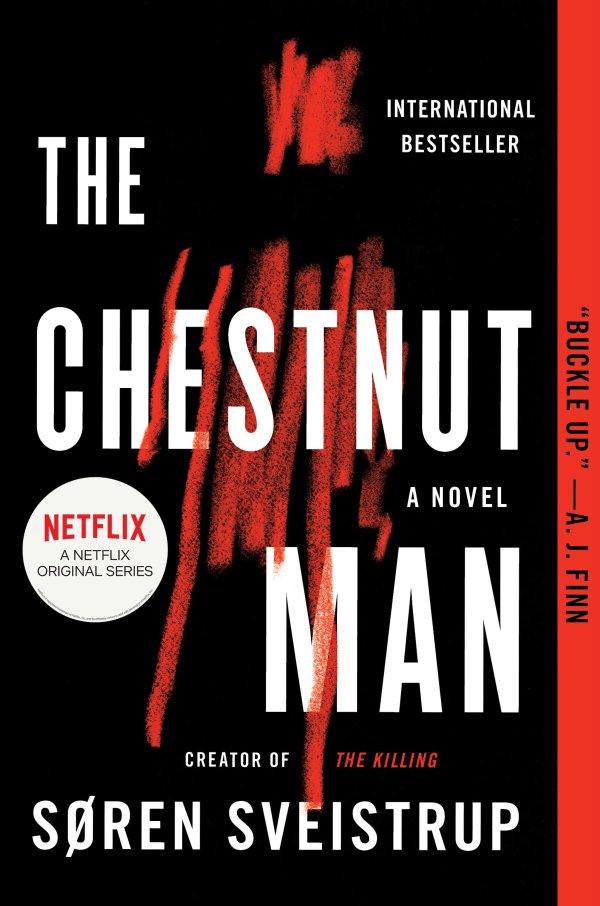
The Chestnut Man, by Søren Sveistrup
The other day the phrase “the summer of our discontent” popped into my head, probably when I was lying around wondering how long it would take for someone to find me if I collapsed in our apartment due to the heat. The unrelenting theme this summer has been fires, heat, and drought. I left a smoky Santa Fe, affected by the Frijoles Fire north of town near Nambé Pueblo. Not as affected as those who live closer to the fire, of course. But I had to pull out Covid masks to sleep with the last two nights I was there since the place just smelled like a campfire. Yesterday I read that authorities were advising people to close all windows and use air filters. I’m sure it’s sage advice but it presumes quite a lot, namely that you have some way to keep yourself cool with the windows closed and that you have access to and money for air filters that you can just buy and put all around your home. A completely dried-up Rio Grande as I flew out of Albuquerque was one of the saddest sights I’ve seen in a long time. Ridiculous temperatures and high humidity greeted me here in Torino. Luckily, I’ve been able to distract myself somewhat with The Chestnut Man, by Danish author Søren Sveistrup.
Danish Noir
Unlike other reading this summer which has struck a little too close to home in terms of climate and heat unbearability (I’m looking at you, A Guardian and A Thief), The Chestnut Man is Danish noir which takes place during late autumn. This sounds so refreshing right now! Chestnut men, kastanjemænd in Danish, are a common arts and crafts project for children in Denmark. You use chestnuts to make the bodies and heads, with toothpicks for the arms and legs. As the back cover of Sveistrup’s book states, “If you find one, he’s already found you.” And “he” is someone you definitely don’t want finding you.
Fast Read for a Doorstopper
For a Doorstopper, this book, skillfully translated into English by Caroline Waight, moves. It’s a fast read, which you would expect for a crime novel, but it also holds up to being set down and picked up again over a long period of time, which is good since that’s how my reading’s gone all summer.
The main character is ostensibly a female detective, Naia Thulin. However, as the story unfolds, it focuses more on Hess, a Dane who works for Europol but who has been shipped back to Copenhagen for reasons unknown. Stuck with “the man with the eyes” (one blue and one green), Thulin seems annoyed most of the book. I enjoyed Hess as a character, more so than Thulin, but maybe that’s because we don’t get as much character development with her.
Gruesome Killing
The novel opens with a violent event on a farm thirty years in the past. We are left to wonder about the significance of that until much, much later in the book, which was fine by me. Chapter 1 fast forwards us to the present day, where we’re in the point of view of one of the victims of a gruesome killing. We discover shortly thereafter that Rosa Hartung, the minister of social affairs, and her husband have lost their elder child after she disappeared a year prior. Presumably murdered, her body has never been found.
There’s no shortage of ghastly torture, including child abuse, in The Chestnut Man, so reader beware. As with many other crime novels, the pain and suffering seems to fall, to a large extent, on female characters. It’s one reason I sometimes hesitate to read such stories, although wishing the pain and suffering were more equally distributed doesn’t seem like the right argument, either. For what it’s worth, the infliction of the violence is backed up by a particular motivation on the part of the killer. This lends to a deeper story and the violence comes across as less gratuitous (but no less gruesome). Sveistrup does an excellent job at writing from various points of view, including the female characters. In one scene, Rosa receives further bad news: “The moment she sees his face, she feels the floor evaporate beneath her—just like the day Kristine disappeared.”
Dynamic Between Thulin and Hess
Somewhat predictably, there’s something in the dynamic between Thulin and Hess. I was hoping we’d get more on that front. Not necessarily a romance, but, I don’t know, more. Guess I’ll have to read the second book in the series to see if Hess makes a repeat appearance. I hope so, if only because I liked him so much.
Interplay between Government Figures
The interplay between the various government figures and departments in The Chestnut Man is interesting. Questions arise with respect to the disappearance of Rosa Hartung and her husband’s child. If the case isn’t closed, then somebody screwed up, right? Many characters also have their own agendas, which often amounts to an infuriating desire on their part to cover their own asses, even though that means others will be hurt. Those who are meant to protect and serve may do so only when it doesn’t harm them. I felt for Rosa not only because of the stress related to their daughter’s disappearance, but also because of the pressure that’s put on her for purely political reasons. What’s best for the party takes priority. This, too, is infuriating.
Social Issues
As Donald Maass writes in his fantastic craft book, Writing the Breakout Novel (the workbook is excellent, too), for a novel to be successful, the story needs both personal and public stakes. In The Chestnut Man, the personal stakes are not entirely clear for Thulin and only become clear related to Hess late in the novel. However, preventing murders is a high-stakes universal issue and the police are in a race against the clock. All of this is set against the backdrop of child abuse, another high-stakes issue. The sheer magnitude of these problems is at times overwhelming. Hess, too, despairs: “As he listens impatiently to the hold music on his phone, his eyes sweep across the shelves, and it strikes him what an incredible amount of human suffering must be documented by the state, lying forgotten in archives, registers, and servers up and down the country.”
Tense Ride
The Chestnut Man is a tense ride. In particular, the action ramps up towards the end and does what a thriller should: keeps you reading. By the end, the characters had me hooked, and I wanted the best for all of them except for the killer. Next stop: the Netflix series based on the book. I’ve heard it follows the story faithfully, so we’ll see. After that, the next book in the series, Hide and Seek, which I’ve added to my endless TBR.
How about you? How do you feel about crime novels? Have you read any good ones lately? Let me know in the comments below.
Pulling at Threads is my occasional newsletter. It always accompanies my blog posts. If you want more of an “insider’s” view on what’s happening in my reading and writing life (or just to get notified of the latest post), you can sign up here.