

Writing Fiction is A Long Game
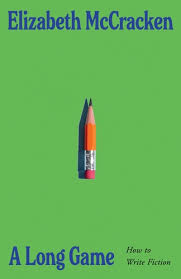
The start of a new year is always a good time to check out a new craft book, don’t you think? Perhaps Elizabeth McCracken’s publishers planned the release date to come just before Christmas, but her new book A Long Game: How to Write Fiction, wasn’t available here on the European side until this month. As soon as it was available, I grabbed a copy.
I hadn’t read a craft book in quite a while, so I thought it would be fun to check it out. Actually, I probably haven’t even opened a craft book since last summer, when I was working on revisions to a novel. So it was time.
My Initial Reaction
My initial reaction to this slim (200 pages) volume: surprise. The formatting consists of 280 short subsections of numbered text. It instantly reminded me of my old tenth edition of the Harbrace College Handbook. Either that or the Chicago Manual of Style.
McCracken says she loves a good reference book, and it shows. There’s even an index, which blew my mind. She also cautions, though, that A Long Game’s arrangement is based on “vague broad concepts, digressions, flights of fancy.”
Wasn’t What I Was Expecting
I’m not familiar with McCracken’s work. She’s written many novels, short story collections, and also a memoir, none of which I’ve read (yet). After I read the opening pages of A Long Game, I wasn’t sure what to make of this book (translation: I wasn’t sure I liked it). It wasn’t what I was expecting, that’s for sure, although I don’t really know why that is. Maybe, nerd that I am, I thought it was going to be a more straightforward book on technique. The formatting is straightforward, true, but the content isn’t, not exactly. Initially, I found the whole thing slightly off-putting, I have to admit.
Then, just as McCracken mentions in a subsection about the “surface tension of language,” I realized that I was getting into the rhythm of the book. At the outset, I thought her advice fell primarily into the category of inspiration. But as I continued to read, I gleaned several salient points on technique. It’s not all that important which points those are, because everyone will take away something different, but I’ll give a couple of examples below.
Playwriting
I know zip about plays, let alone playwriting. Maybe, maybe I’ve been to five plays in my lifetime (What can I say? I love musicals.). I don’t know why that is, because I enjoy them when I go. A few years ago, I was lucky enough to see Keri Russell and Adam Driver in Lanford Wilson’s Burn This. But playwriting? It has never crossed my mind.
When McCracken was in college, she submitted for and got into a playwriting class. There, she explains, she learned how to look at a piece of work at a remove, and in collaboration with others. The class discussed practical aspects of submitted plays, and went over details again and again. Getting the work out of her head and having to look at it in this way allowed her to pay attention to structure, architecture, and tension, as she puts it.
I may have to pick up a copy of Burn This. As a Pulitzer Prize winner, I can think of worse places to start. I may never write a play, but I think reading one would be instructive.
Connectedness between Plot and Emotion
Another very interesting point McCracken addresses is the lack of connectedness between plot and emotion she sees in her students’ writing. According to her, this occurs when the active plot and emotional plot in a story kind of travel along on parallel lines, never meeting. She states: “Where real, true plot occurs is where the active and the emotional interact, when event affects what characters feel, and what they feel affects what they do. It’s not a one-to-one correspondence, feel/act/feel/act.” (Emphasis in original.)
This information is accompanied by a few simple, yet practical line drawings. As she says, it’s common to read stories where the events either don’t seem to be happening to the characters, or when the characters “merely endure” the plot. I hope to keep these points in mind the next time I draft a story.
Surface Tension
Over at Doorstoppers we’ve been reading Tom’s Crossing, by Mark Z. Danielewski. This mammoth book (1200+ pages) is a perfect example of what McCracken refers to when she talks about the “surface tension” of language. As she explains, “All fiction is a body of water: language is the surface.” Some language has a higher surface tension, reflected in the “difficulty, eccentricity” of its language. In a word, some language is tricky.
Danielewski’s book is definitely tricky, but so far rewarding. As McCracken describes, I’ve fallen in, and I’m now swimming through “the world of the book.” I suppose if you can’t get past the surface tension of a particular book’s language, then it isn’t the book for you. I’m finally at the point, though, where I’m in sync with the surface tension of Tom’s Crossing.
Something for Everyone
All in all, I think A Long Game is a good book to have around, especially if you only feel like reading a subsection here and there. No muss, no fuss. There’s something for everyone. Although I was a little bit put off at the outset, by the end of the book, I realized I had highlighted a lot of things that I can go back to when I need advice on point of view, for example, or some other craft element. But I’ll also be able to turn to it again when I need a shot of inspiration.
Finally, I’m curious to read McCracken’s memoir. In it, she recounts the loss of a stillborn child. Despite the heavy subject matter, I’ve read that her sense of humor comes through. As she said in A Long Game, humor is a good thing, and often missing in our writing. I’m curious how she used it in the face of such a tragedy.
How about you? Read any good craft books lately? Let me know in the comments below.
Pulling at Threads is my occasional newsletter. It always accompanies my blog posts but I sometimes send infrequent updates on other goings on. If you want more of an “insider’s” view on what’s happening in my reading and writing life (or just to get notified of the latest post), you can sign up here.