

Tom’s Crossing – A Review
If you can get out of the paddock, you’re in for a ride.
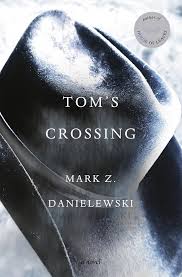
A couple of months ago we decided to go straight from House of Leaves to Mark Z Danielewski’s newest, Tom’s Crossing. This was a big ask of the Doorstoppers members but it won the poll, so we decided to forge on. I’ll say it up front: this book is not for everyone. It gets off to a very slow start. But if you can get out of the paddock, you’re in for a ride.
Setting
The setting is Orvop, Utah (an anagram for Provo), 1982. All the events of this massive, 1232-page novel take place over the course of four to five days, Halloween weekend. The main characters are Tom, Kalin and Landry, teenagers who all attend the same high school. Tom and Landry Gatestone are siblings. Kalin March, a recent arrival to Orvop with his mom, is in the same class as Tom.
And then there’s the various commentators whom we can never really behold, a Greek chorus of sorts, but only if we accept that at one point or another we are all of us a member of such a chorus, conscripted by tales told.
If you hated House of Leaves, you probably couldn’t stand the format. So many footnotes! Tom’s Crossing doesn’t have footnotes, but it has many, many, many asides. These can be irksome at the outset. But Danielewski makes no bones about the fact that many of the side characters function as a Greek chorus. He even addresses this near the beginning of the book: “And then there’s the various commentators whom we can never really behold, a Greek chorus of sorts, but only if we accept that at one point or another we are all of us a member of such a chorus, conscripted by tales told.”
Get Into the Rhythm
Once you get into the rhythm of the book, you’ll be hooked by this tragic, violent story. At its heart, it revolves around two of the teenagers trying to save a pair of horses, Navidad and Mouse, from the abattoir, which is owned by the Porch family. Kalin has promised Tom he’ll save them, and his plan is to take them up a steep, almost inaccessible path to the top of a nearby mountain, where a meadow, and freedom, awaits.
For the most part chapters are long. The text is dense and the dialogue style is somewhat similar to Cormac McCarthy’s. There are no quotation marks. It’s easier to manage than McCarthy’s dialogue, though, because it’s all italicized. It flows easily, as does the story language in general, which takes every opportunity possible to drop a “g” from word endings. I loved the style. It’s natural.
Strong Women and Other Likable Characters
One of my favorite aspects of the book is that all of the principal female characters are strong women. Landry Gatestone, Sondra Gatestone (Tom and Landry’s mother), and Allison March (Kalin’s mother) are a joy to read. In particular, I loved Landry, whose sass and humor persist, despite the horrible circumstances that befall everyone involved.
Sondra and Allison, too, support each other, developing an almost immediate bond, even though they’re different from each other and could have just as easily become adversaries. Their cooperation and tenacity are inspiring. Another plus is that we get the points of view of several of the horses. Stories of where they were born, and their lives up to the time of the book add another layer of complexity which I enjoyed.
Horrible Villain
When we read East of Eden in Doorstoppers, I thought I had read the worst villain of all time, Kate. That was before I was introduced to Old Porch. The patriarch of the Porch clan (who hate the Gatestones), he’s abominable. Most of his eight sons are just as bad. His wife and young daughter have managed to fly the coop to Texas along with the only son out of all of them who seems to have his head on straight, Hatch. Hatch has become a Texas Ranger, a fact important to the story.
Speaking of East of Eden, the more I think about Tom’s Crossing, the more I feel that, if pressed, I would describe it as a combination of East of Eden and No Country for Old Men. I only say this to give potential readers a flavor for what awaits them. Hopefully, you’ll excuse what is a reductive statement. Similar to East of Eden, Tom’s Crossing has a long-standing feud between two important families. And like No Country for Old Men, it has a stunning amount of violence.
Kill the Dog
Stephen King has often been quoted as saying that the fastest way to get hate mail is to kill the dog. Actually, in his book On Writing, what he said was that he received a deluge of letters protesting his “outrageous cruelty to animals” in The Dead Zone. He somehow felt the need to respond to those readers by reminding them that the villain in the book wasn’t real, nor was the dog, and that he would never harm an animal. Violence, according to King, establishes how dangerous a character is.
In the case of Tom’s Crossing, there are some scenes which were truly shocking. If you need a reminder as to part of the setting, go back up to the beginning of this post. But the instances of violence fit the story, and the characters’ behavior is totally in line with their personalities and the situations they find themselves in. That being said, if you didn’t like East of Eden or No Country for Old Men, my guess is you won’t like Tom’s Crossing, either.
Surrounded by Death
Along with violence, you’ll be surrounded by death. I don’t know if it’s the fact that Danielewski is on the cusp of turning sixty, but he seems to have felt the need to tell us the causes of death of almost everyone mentioned. This includes witnesses to the main story. It must be part of a larger theme, although it’s still something I’m trying to work out. Particularly towards the end of the book, each aside seems to include everyone’s cause of death.
Mythology and Mormonism
Just like with House of Leaves, I’m sure there are a ton of things I missed in Tom’s Crossing in terms of references and even overall point. I’m at a loss when it comes to mythology, so those references went over my head, although they did provide some food for thought. Maybe they’ll motivate me to read more mythology.
One aspect I know somewhat more about is Mormonism. Growing up, I remember having classmates who were Mormons, and how at pool parties they never drank Coke. There were other, less innocuous things, too, like how someone had been ostracized for dating a Black classmate. One of the immersive experiences in Tom’s Crossing is observing how the various characters relate to each other and to their religions, or lack thereof, and what role religion plays in those interactions. As with death, mythology and Mormonism become important presences in the novel.
A Master Class in Character Development
One of Tom’s Crossing’s selling points, along with the underlying story itself, is that it’s a master class in character development. The cast of characters is large (remember how many Porch sons I mentioned?), but they’re all memorable in some way. You really get to know them, and I think you would recognize the main characters if you met them in real life. Creating characters that pop off the page like that is a real talent.
Elaborate fictions prepare us for elaborate realities.
Some Books Make You a Better Reader
Some books make you a better reader. Tom’s Crossing is one of them. Unless you’re already a walking dictionary, you’re bound to learn some new vocabulary. If you’re learned enough to get all the literary, art, and mythological references, you’ll enjoy the book that much more. I enjoyed all the Eighties movies and music references. As I said in my newsletter, the mention of Up Where We Belong prompted me to watch An Officer and Gentleman again. This book is complex, but as one of the (side) characters puts it: “Elaborate fictions prepare us for elaborate realities. And if nothin else, reality is elaborate.” If that isn’t the truth, then I don’t know what is.
Enjoy the Ride
If you’re looking for a light, fast read, Tom’s Crossing isn’t it. You need to sit down with this book when you know you have at least some small blocks of time. It’s not the type of book you just pick up and read when you’re riding from one bus stop to another. It requires focus. The fact that people seem frustrated with its style might say more about the current state of our collective attention spans than the book itself. If you need an extra push, I wholeheartedly recommend the audiobook, expertly narrated by Susan Dalian.
If, however, you’re looking for a story and characters that will stick with you probably forever, and you’re willing to be patient and really sink into the story, then I wholeheartedly recommend Tom’s Crossing. The payoff is an engaging, devastating story with an extremely satisfying ending. Approach it with the right mindset, then sit back and enjoy the ride. It’s worth it.
Have you read Tom’s Crossing? What did you think? If not, do you think you’ll give it a try? What books are on your radar? Let me know in the comments section.
Pulling at Threads is my occasional newsletter. It always accompanies my blog posts but I sometimes send infrequent updates on other goings on. If you want more of an “insider’s” view on what’s happening in my reading and writing life (or just to get notified of the latest post), you can sign up here.